Nurture
Use patience, pleasant surroundings and supportive communication. Losing a word or needing more time is not a character failure.
You may not control how much clarity is available today. You still deserve a voice in what receives your attention.
The mind needs trails.
Not traffic.

Brain fog is not a test of willpower. Choose one adjustment that reduces demand.
Sit or recline, support your head and arms, loosen unnecessary muscle effort, and address heat, thirst, hunger or upright symptoms according to your care plan.
Reduce background sound, glare, motion, conversation and notifications. Give the brain one signal to follow.
Write one sentence, record a voice note or leave the object where it will cue you. Do not make working memory hold the plan.
Open one document, answer one question or complete one visible step. Multitasking often increases cognitive demand.
If processing is slipping, ask for written information and time to respond. A slower answer can be a safer answer.
Call emergency services for sudden confusion; trouble speaking or understanding speech; new one-sided weakness or numbness; sudden vision loss or change; a sudden severe headache; seizure; new loss of balance or coordination; or cognitive changes with fainting, head injury, chest pain or severe breathlessness. Do not assume a sudden change is ordinary brain fog.
Traffic is constant input: notifications, layered noise, scrolling, switching tabs, urgency and information arriving faster than it can be processed.
A trail is intentional: one idea, one page, one conversation, one puzzle or one creative task followed at a manageable pace.
Stimulation keeps the mind occupied.
Exercise asks it to engage.
Neither replaces recovery.
A healthy relationship with attention includes challenge, meaning and quiet. More input is not automatically more enrichment.
Use patience, pleasant surroundings and supportive communication. Losing a word or needing more time is not a character failure.
Choose input with substance: music, nature, thoughtful reading, art, learning or a genuine conversation—not only whatever appears next.
Recall before looking up, learn one small skill, solve a puzzle, write by hand, practice a sequence or explain an idea in your own words.
Reduce screens, decisions, sound and conversation before the mind reaches shutdown. Switching to easier content may still be input.
Let information settle. Quiet, journaling, a view through the window or revisiting an idea later can help experience become understanding.
A chair, reclined position, mobility aid, adaptive tool, voice control, quiet room, shorter time limit or help with setup may be what makes participation possible. Accommodation is not the opposite of engagement.
Discuss what you watched, write one thought, sketch a scene, notice the music or connect the idea to your own life.
Hum, tap a rhythm, choose the next song, play a simple phrase or build a small playlist with intention.
Complete one seated step of cooking, gardening, organizing, creating or caring for something. Participation can be brief and adapted.
Decide what deserves your attention before an algorithm, notification or sense of urgency decides for you.
Your energy is limited, but it is still yours. You deserve a say in what receives it.
The goal is purposeful participation that leaves room to process—not maximum difficulty.
Listen to one familiar song and notice an instrument. Sort a few photographs. Name three details in the room. Recall one pleasant part of the day.
Read one page, complete a short puzzle, follow a familiar recipe, write a paragraph or learn one new fact—then pause.
Practice a skill, work on a creative project, explore a complex idea or have a focused conversation with a stopping point already chosen.
Understanding, organizing language and deciding may require more time when the brain is managing pain, upright effort, heat, fatigue or competing sensory input.
“Please ask one question at a time.”
“I need that in writing.”
“Give me a moment—I know what I want to say.”
“I’m not ready to decide. I’ll respond later.”
“Can we move somewhere quieter?”
Use one dependable capture place for appointments, tasks and questions. Keep supplies where they are used. Photograph where you parked. Put the item that must leave with you beside the door. Use labels, alarms, checklists, pill organizers and written steps without shame.
For reading, stop after a short section and ask, “What did I just understand?” Write one sentence before continuing. This is active processing—not a remedial exercise.
A tiny notebook, voice note or single phone list can preserve a thought before it disappears.
Turn “get ready” into visible steps. One instruction is easier to re-enter after interruption.
Default meals, clothing combinations and repeatable routines save decision-making for what matters more.
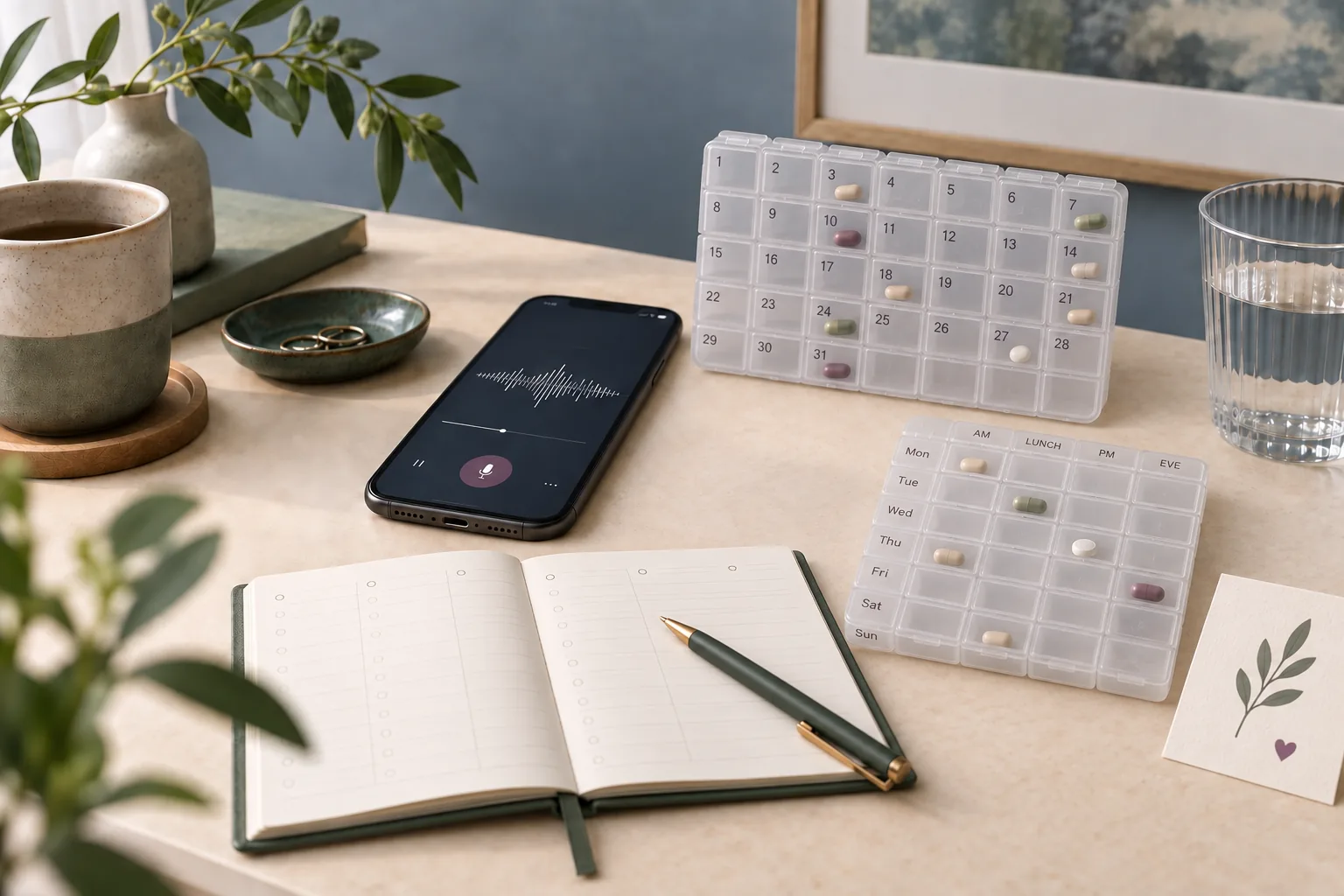
Neuroplasticity is the brain and nervous system’s ability to adapt with experience. Small, repeated routines can make a useful path more familiar: one place for notes, one sequence for medications, one pause before the next task. This is not a promise that someone can “retrain” their way out of dysautonomia. It is permission to build supportive patterns while respecting symptoms, rest and medical care.
When pain, symptoms and schedules are already competing for attention, offloading the remembering can leave more capacity for living.
Use voice dictation, a voice note or one quick-entry list for ideas, questions and dates. Capture first; organize later.
Choose an app or simple digital note for a few consistent markers—meals, hydration, symptoms, pain, sleep and activity. Bring summaries or trends to appointments instead of asking your memory to reconstruct the week.
Use a clearly dated organizer suited to the prescribed schedule: morning and evening, mealtimes or several daily time slots. Keep an updated medication list with names, doses and timing.
Create recurring alerts for hydration, medication times, pharmacy refills, planned rest, meals and brief position changes or movement when appropriate for you.
Choose one small activity that fits today’s physical and cognitive range. The goal is not a streak, perfect score or maximum effort; it is meaningful participation without borrowing heavily from recovery.
Look for customizable stretch, mobility or fitness apps with seated, reclined and limited-mobility options, short sessions, pause controls and adjustable intensity. Save clinician-approved physical therapy routines so the next step is already chosen. Stop for concerning symptoms and follow your care plan.
Try a safe, simple action with your nondominant hand—moving game pieces, sorting objects, tapping a rhythm or brushing a tabletop. Keep knives, heat, heavy objects and balance-demanding tasks out of the experiment.
A podcast or audiobook can make learning available while the body is supported. After a short section, pause and name one idea you remember. Try the “learn to teach” method: explain it aloud in plain language as if sharing it with a friend.
Keep a few easy, nutrient-dense options ready: avocado toast, hard-boiled eggs, frozen berries, oatmeal, yogurt, nut or seed butter, prewashed produce, whole-grain crackers, or a simple chicken, tuna, bean or chickpea salad. Combine what you tolerate instead of creating an elaborate meal.

“Brain food” is not a cure. Food supports overall nourishment and energy; no single ingredient treats brain fog. Adjust choices for allergies, GI symptoms, histamine sensitivity, swallowing needs, diabetes, kidney or heart conditions, and any sodium, fluid or nutrition plan from your care team.
Did I choose this—or did it simply appear?
Is it nourishing, useful or enjoyable—or only difficult to stop?
Am I engaging with it, or absorbing more than I can process?
How does my mind feel afterward?
Do I need another input—or space to digest the last one?
You do not have to fill every silence. Some of the mind’s most important work happens after the input stops.
Sleep is active biological work. During sleep, fluid pathways help move waste products through and away from brain tissue, and sleep stages help stabilize learning and memory. The popular “dishwasher for the brain” image is useful—but it is a metaphor for a complex system still being studied, not a promise that one perfect night resets everything.
Deep sleep and REM are not switches you can force. You can create conditions that make a full night of restorative sleep more possible.
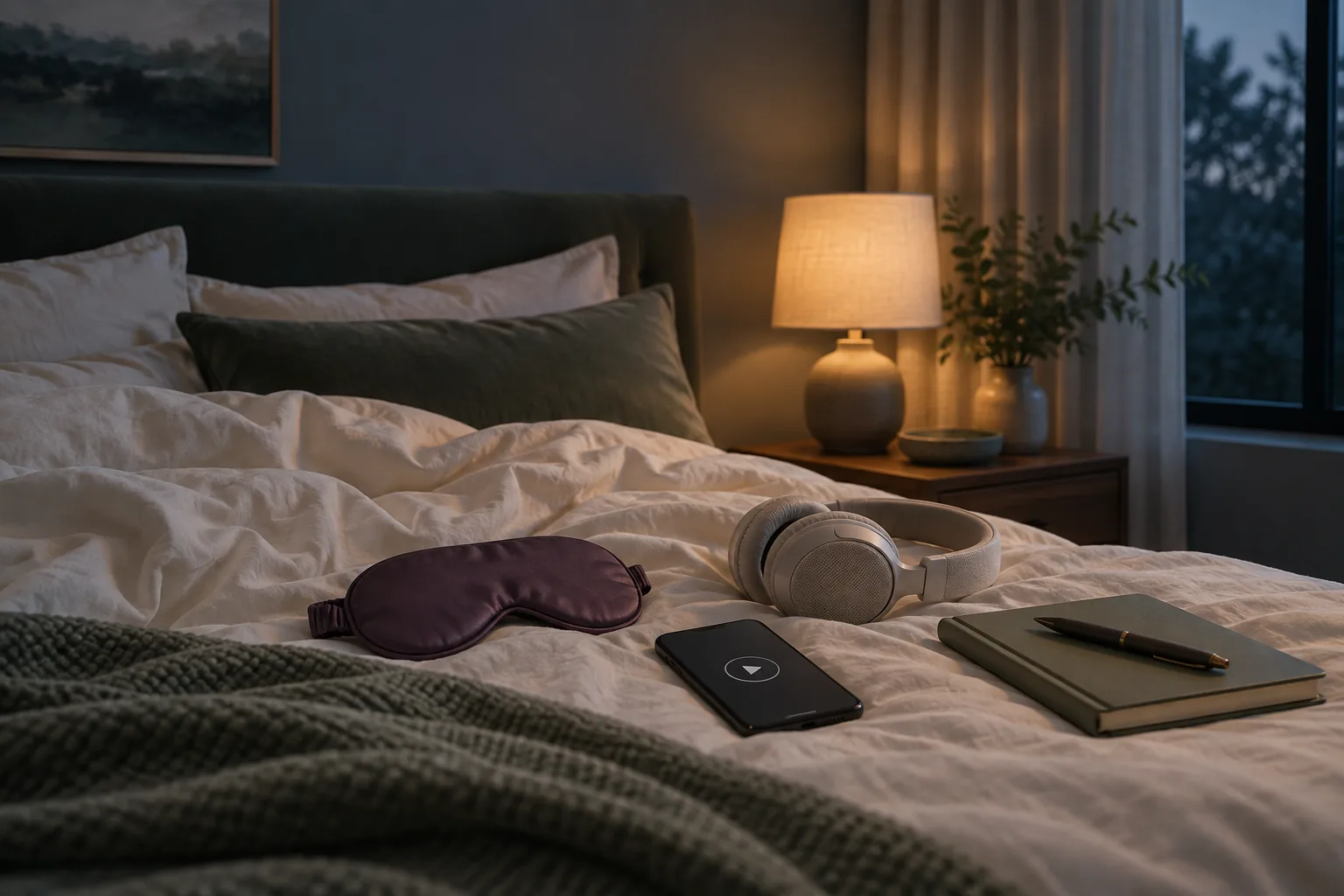
Dim the room, reduce bright screens and choose content that does not create urgency. CDC guidance suggests turning devices off at least 30 minutes before bed; use a longer runway when that feels helpful.
Try a familiar audiobook, gentle podcast, guided imagery, quiet music or a body-scan recording. Use a sleep timer, lower the volume and place the screen face down so listening does not become scrolling.
Adjust pillows, temperature, noise and light for your body. Prepare needed water, medication and mobility supports before settling so fewer decisions are waiting at bedtime. Follow your prescribed medication and hydration plan.
Choose a few repeatable cues: wash up, change the lighting, write tomorrow’s one essential note, start the same audio and settle into your supported position. Familiarity can reduce decisions even when sleep timing varies.
Change one variable long enough to notice whether it helps. A long checklist performed anxiously is not a relaxing bedtime routine.
A reasonably consistent wake cue may be more useful than forcing an exact bedtime. Open the curtains or seek safe morning light when possible; light helps set the body clock. Accommodate delayed sleep, shift work and symptom-heavy mornings with your clinician.
Rest may be medically necessary. If naps appear to make nighttime sleep harder, experiment with an earlier or shorter nap—NHLBI suggests about 20 minutes for adults with nighttime sleep difficulty. Do not withhold needed rest to chase a perfect schedule.
Notice afternoon or evening caffeine, nicotine, alcohol, decongestants and the timing of medications or supplements. Ask a pharmacist or prescriber what can affect sleep and whether timing can safely change; do not alter it on your own.
Before winding down, write the worry, question or next task in one trusted place. Add the first tiny action if useful. The goal is not to solve it at night—it is to reassure the brain that the thought has somewhere to wait.
For one or two weeks, note bedtime, estimated sleep, awakenings, naps and how restored you feel. Look for broad patterns rather than perfect device scores; consumer wearables estimate sleep and can sometimes create more worry.
If illness keeps you in bed, change the cues instead of blaming the location: raise the head safely, open curtains, switch pillows or blanket, use daytime audio and keep nighttime lighting distinct. Let the environment signal a transition even when the furniture cannot.
Sleep hygiene can support sleep, but it is not a stand-alone treatment for chronic insomnia. Cognitive behavioral therapy for insomnia (CBT-I) is the gold-standard treatment and can be adapted for medical conditions with a qualified clinician. Ask about an evaluation rather than adding more pressure to “try harder” at sleep.
Stop before attention collapses. Let the body settle and the idea consolidate. Return because there is capacity—not because the timer, feed or unfinished task demands it.
Upright symptoms, dehydration, heat, poor sleep, pain, migraine, medication effects, illness, anemia, thyroid problems, nutrient deficiencies, ADHD, ME/CFS and other conditions may overlap. Persistent or worsening cognitive changes deserve evaluation rather than automatic attribution to dysautonomia.
Orthostatic intolerance changes circulation and increases the body’s work while upright. Some people report worse attention, processing and mental clarity when standing, although symptoms can also continue while reclined.
Working memory has limited space. Switching repeatedly between tasks requires the brain to reload context, which can increase errors and cognitive fatigue.
Even low-effort content can involve rapid visual change, emotional cues, reading, choices and constant novelty. Physical stillness is not necessarily sensory or cognitive rest.
Occupational therapy, speech-language therapy, neuropsychology, rehabilitation medicine or another appropriate clinician may help assess function and build individualized strategies.
Community ideas are possibilities—not proof or universal treatment. Medical sources guide safety; lived experience helps reveal usable adaptations.
This page offers general education and practical accommodations. New, persistent or function-limiting cognitive symptoms deserve individualized medical evaluation.
Support the body. Choose the engagement.